· Nº 08 — Araskova Studio · on request · TITAN v0.1.0
Titan. — edge vision with persistent identity, from Araskova Studio
Edge vision · persistent identity · on-premises
Runs next to the cameras a site already has. It tracks every person with an ID that survives blind spots (out of view through a door and back, same ID), flags weapons and enrolled faces, and keeps all footage on the premises.
Drawn illustration of TITAN's HUD on abstract figures — tracking, threat profile, out through a door and re-acquired
· 001 — Measured
4-core CPU only
- Detector latency
- 27.6ms
- Accuracy kept by INT8
- 0.443mAP50-95
- Live throughput
- 23fps
- Re-ID scenarios passed
- 8/ 8
- Re-acquisition time
- 0.27s
- HUD render
- 1.9ms
yolov8n-640.int8 p50, CPU
src · bench_models
COCO128; FP32 0.451
src · bench_models
720p, glass-to-glass p50 97 ms
src · titan run --realtime
re-acquire, no false merge, swap correction
src · reid_suite
door to restored ID, worst case
src · reid_suite
full overlay per frame, p50
src · titan bench
· 002 — Capabilities
19 capabilities Verified Built, field test pending Planned
Perception[04]
- ●
Threat engine
YOLOv8 / YOLOv10 (NMS-free) object and weapon detection through ONNX Runtime from Rust, INT8 by default.
- ●
Biometric matrix
SCRFD face detection, 5-point alignment and 512-d ArcFace embeddings matched against an enrolled gallery (authorised / watchlist).
- ●
Context veto
A weapon class touching benign context (a knife on a dining table) raises Caution instead of Alpha.
- ○
Firearm-trained detector
Fine-tuned handgun / rifle / knife model from site footage plus hard negatives.
Tracking[02]
- ●
Multi-target tracking
ByteTrack association over decoupled Kalman filters with a 10-frame trajectory ring and projected motion vector.
- ●
Range and closing speed
Monocular pinhole range per person/vehicle; truncated boxes are excluded so edge-of-frame bodies don't fake an approach.
Identity[07]
- ●
Persistent person IDs
Every person gets a global ID (P-0007) that survives leaving view: restrooms, doorways, long occlusions.
- ●
Re-acquisition
Returning people are matched by face print, clothing signature and optional learned re-ID, with portal-zone priors and an ambiguity margin (never a forced merge).
- ●
Crossing guard
When two identified people cross and the tracker swaps them, the swap is detected after they separate and undone.
- ●
Threat memory
Someone who was Alpha (armed, watch-listed) when they left is Alpha again when they come back.
- ●
Zones and events
Portal / entrance / restricted zones; enter, exit, re-enter and zone events as JSON lines; occupancy and unique-visitor counts.
- ◐
Learned re-ID model
Plug in any [1,3,256,128] -> [1,D] ONNX (OSNet / FastReID) for look-alike outfits.
- ○
Multi-camera hand-off
Shared identity registry across cameras.
Output[02]
- ●
Tactical HUD
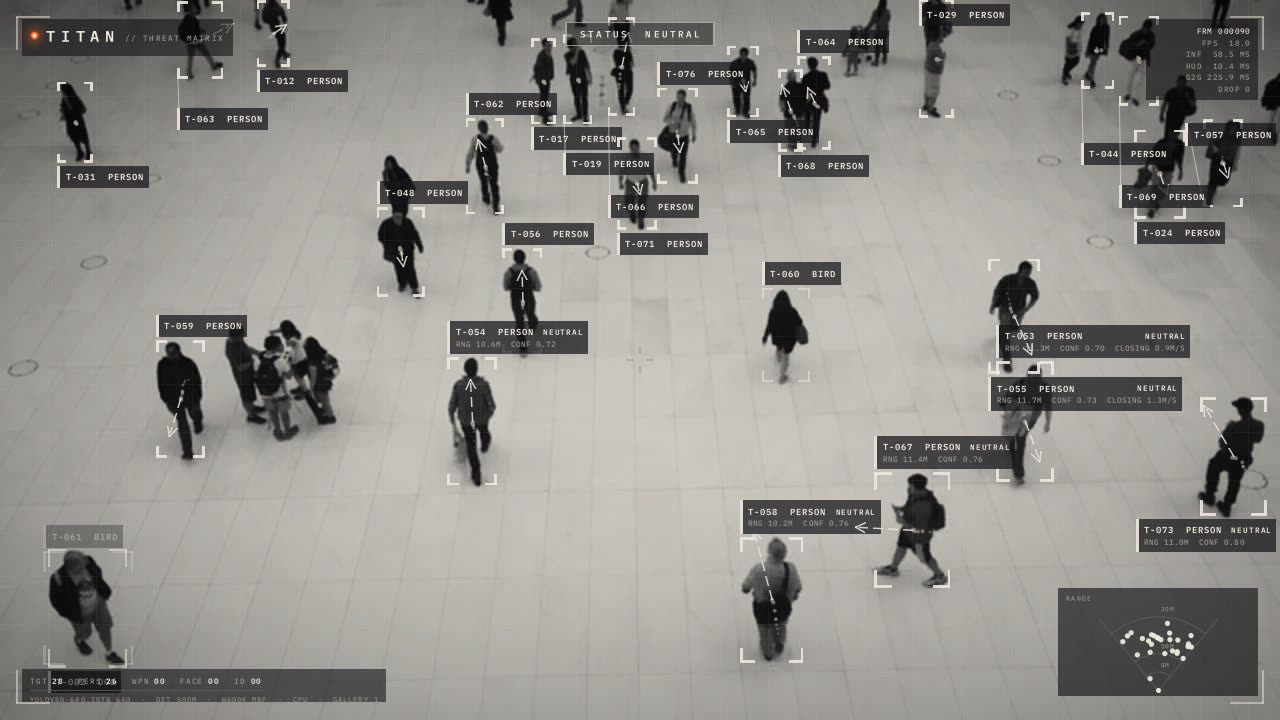
Targeting brackets, threat profiles, trajectories, range radar and identity overlays in the Anvin / Araskova ink-bone-signal palette.
- ●
Threat-matrix metadata
Per-frame JSON with every track, level, range, velocity, identity and timing; H.264 / RTSP video out.
Learning[02]
- ●
Data flywheel
Uncertain weapon detections and every Alpha onset are saved with YOLO pre-labels for review (CVAT / Label Studio).
- ●
Fine-tune and tune
One command trains on tactical data, exports ONNX + INT8, benchmarks accuracy vs latency and derives per-class thresholds.
Deployment[02]
- ◐
Live cameras
RTSP / ONVIF streams, V4L2 / MIPI devices via ffmpeg, with latest-frame (drop-stale) live semantics.
- ◐
GPU / NPU acceleration
TensorRT (Jetson Orin) and OpenVINO (Intel Core Ultra) execution providers behind cargo features.
· 003 — Threat engine
Accuracy vs latency · COCO128
Every exported variant is scored for accuracy and timed on the same machine. The deployed model is INT8 with the detection head kept in full precision: within a point of FP32 accuracy, about 1.5× faster.
| Model | Precision | Input | mAP50-95 | p50 ms | Latency (p50) |
|---|---|---|---|---|---|
| yolov8n-640 | FP32 · NMS | 640 | 0.451 | 41.0 | |
| yolov8n-640.int8deployed | INT8 · NMS | 640 | 0.443 | 27.6 | |
| yolov8n-320 | FP32 · NMS | 320 | 0.377 | 13.4 | |
| yolov8n-320.int8 | INT8 · NMS | 320 | 0.374 | 10.8 | |
| yolov10n.e2e | FP32 · NMS-free | 640 | 0.455 | 39.8 |
· 004 — Pipeline
1280x720
- Offline throughput
- 19 fps
- Live throughput
- 23 fps
- Glass to glass p50
- 97 ms
- Glass to glass p95
- 123 ms
- Stale frames dropped
- 73 / 300
- Identity mixer p50
- 0.07 ms
Live mode never queues: when inference falls behind, the oldest frame is dropped so the overlay is always about now.
Stage latency · p50 bar, p95 tick · ms
- detector infer33.7
- face detect15.0
- face embed (1)14.3
- hud render1.9
- perception (parallel)37.7
- preprocess0.9
· 005 — Persistent identity
8 / 8 scenarios
Someone goes out through a door. A few seconds later they come back: Titan gives them their old ID, and if they were flagged when they left, they're flagged when they return.
Face prints, clothing signature and the door they used are fused; a stranger leaving the same door gets a new ID, and a tracker swap when two people cross is detected and undone. Wrong-ID frames across the suite: 46 of 6830 (0.67%).
Drawn illustration — the person who leaves gets their ID back; a stranger from the same door does not
| Scenario | Faces | Cue | Re-acquire | Result |
|---|---|---|---|---|
| stranger exits after A is back | on | face | 0.27 s | Pass |
| stranger exits after A is back | off | appearance | 0.27 s | Pass |
| look-alike stranger exits after A is back | on | face | 0.27 s | Pass |
| look-alike stranger exits after A is back | off | appearance | 0.27 s | Pass |
| look-alike stranger exits while A is inside | on | face | 0.27 s | Pass |
| look-alike stranger exits while A is inside | off | appearance | 0.27 s | Pass |
| stranger exits while A is inside, then crosses A | on | face | 0.27 s | Pass |
| stranger exits while A is inside, then crosses A | off | appearance | 0.27 s | Pass |
· 006 — What it does
System output · drawn scenes
Every person, one ID
Each person gets a global ID and a trajectory the moment they appear, and keeps it.
Threat, with context
An object in hand raises the profile to Alpha. A knife on a dining table is Caution, not Alpha.
Crossing guard
When two people cross and the tracker swaps them, the swap is detected and undone.
· 007 — How these were measured
- Machine
- Intel(R) Xeon(R) Processor @ 2.10GHz · 4 cores
- Accelerator
- none (CPU)
- Runtime
- ONNX Runtime 1.28.0 · cpu
- Build
- titan 0.1.0 · 8702f29
- Generated
- 2026-10-01
- All figures were measured on a 4-vCPU shared Intel Xeon with no GPU. Production edge hardware will differ; re-run tools/showcase.sh on the target.
- The stock COCO detector has no firearm class and is weak on knives; a weapon model must be fine-tuned on tactical data (none was available here).
- The re-identification suite uses composited COCO people in a synthetic corridor: it proves the logic (re-acquire, no false merge, swap correction), not field accuracy.
- Sub-5 ms detection needs GPU/NPU acceleration; the TensorRT / OpenVINO paths are built but were not benchmarked here.
- Face recognition is regulated (GDPR, India DPDP Act 2023, BIPA, EU AI Act): enrol only consenting people. The bundled InsightFace models are non-commercial.
- The crowd frame is TITAN's HUD on a public COCO dataset image. The animations are drawn illustrations of TITAN's behaviour on abstract figures, not recordings of the system.
- The deployed detector is Ultralytics YOLOv8 (AGPL-3.0). Commercial deployment needs an Ultralytics enterprise licence or a detector under a permissive licence.
· + — More from Araskova
What works today, first
- Nº 01Open SourceAERIALOpen-source, local-first canvas framework for productivity.Open→
- Nº 02Live PlatformCERBERUSA security skill book for AI agents: policy guardrails, local audits, Git patches.Open→
- Nº 03Live CommercialAXISFull-stack facility operations, check-ins & WhatsApp renewal automation.Open→
- Nº 04Open Source · AlphaCUVWhat cargo is to Rust — for C and C++. One binary, zero config.Open→
- Nº 05Free Web StudioQR GODHigh-performance vector QR engine with zero paywalls or tracking pixels.Open→
- Nº 06On requestVIGILCatch defective units on high-speed conveyors before they ship.Open→
- Nº 07On requestARGUSReal-time alerts from the CCTV cameras you already have.Open→